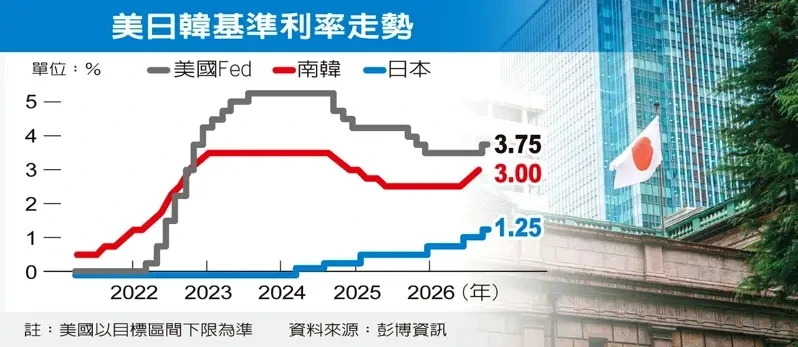
According to a Bloomberg report on the 13th, citing informed sources, officials at the Bank of Japan (BOJ) are still weighing the possibility of another interest rate hike before the end of the year. However, they appear inclined to hold off this month, avoiding the rare move of raising rates in consecutive meetings. Meanwhile, the Governor of the Bank of Korea (BOK) stated that the central bank would maintain a restrictive monetary policy stance until inflation returns to its target. Even the South Korean President made a rare comment, suggesting that South Korea should narrow its interest rate differential with the United States to align with the global trend of monetary tightening.
Sources indicated that, given the lack of signs suggesting an imminent, sharp acceleration in inflation, BOJ officials see little need for back-to-back rate hikes. Instead, the central bank intends to carefully evaluate economic data to determine whether another hike is warranted—potentially as early as its December meeting.
In September, the BOJ raised its benchmark rate to 1.25%—its second hike in three months, marking the fastest pace of tightening since 1990. Historically, however, the BOJ has not raised rates in two consecutive months since 1980; the bank has long preferred to observe the impact of policy adjustments before taking further action.
Pricing in the overnight index swap market currently suggests a roughly 10% probability of a BOJ rate hike this month, while the likelihood of a hike by December has risen to 88%. Among economists surveyed last month, about one-third expected the BOJ to take action in December, while more than half anticipated that it would wait until January of next year.
Separately, Reuters reported that Bank of Korea Governor Shin Hyun-song—who is in Bangkok for the IMF-World Bank annual meetings—stated on the 13th that the central bank would maintain a restrictive monetary policy stance until inflation returns to its target. He noted that both core and headline inflation in South Korea are expected to remain above the target for some time. As for whether the artificial intelligence (AI) boom might push up the neutral interest rate, he remarked that it remains to be seen.
Meanwhile, South Korean President Lee Jae-myung remarked during a cabinet meeting that South Korea has recently been compelled to raise its policy rate to narrow the widening interest rate gap with the United States and to keep pace with the global trend of monetary tightening. On the 13th, Lee Jae-myung noted that global debt pressures and the Federal Reserve’s hawkish policy stance made an interest rate hike virtually inevitable, even as he expressed concern over rising household debt and the risk of defaults.
South Korea’s benchmark interest rate currently stands at 3%, while the Fed’s federal funds rate is within the target range of 3.75% to 4.00%.
However, Lee’s remarks represent an unusual political intervention in interest rate policy; by law, such policy is to be determined independently by the Bank of Korea. In a country where central bank independence is a highly sensitive issue, the president’s comments could spark concerns regarding that independence.
发送反馈